
 E-Paper



Delhi air pollution: Anand Vihar AQI turns ‘severe’ on Diwali morning; special teams formed to enforce firecrackers ban
Delhi air pollution: AQI may reach severe category in other areas in case of additional emissions from firecrackers and stubble or waste fires on Diwali.

 Prefer HTon Google


The air quality in Delhi's Anand Vihar slipped into the “severe” category on Diwali morning, with pollution levels expected to go up on Thursday evening, even as authorities said strict action will be taken against those violating the firecracker ban.
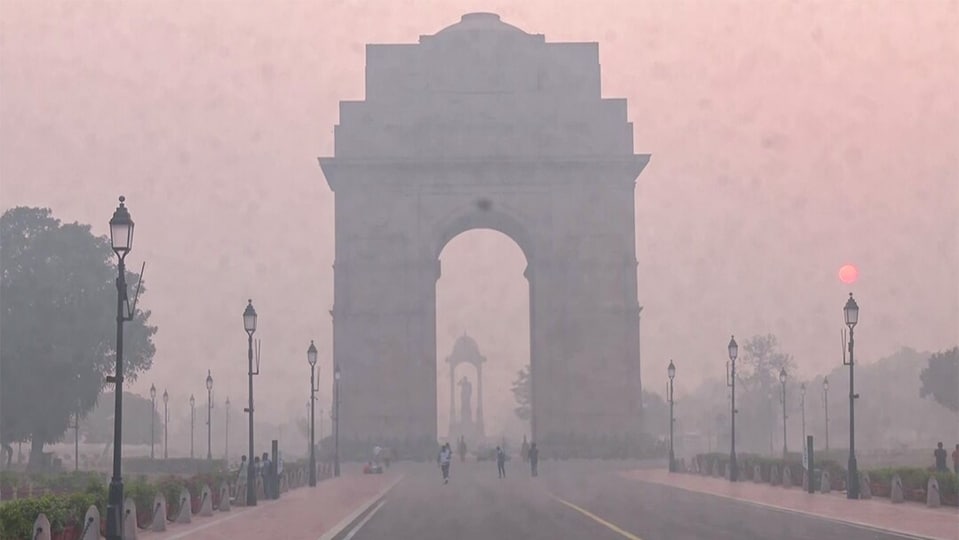
Delhi's 24-hour average Air Quality Index (AQI) was recorded at 307 at 4pm, up from 268 on Tuesday, with PM10 remained prominent pollutant, according to the Central Pollution Control Board (CPCB)
The Indian Institute of Tropical Meteorology (IITM), Pune, said the air quality in the national capital is likely to be in the “very poor” category (AQI 300 to 400) on Thursday and Friday.
At 8am, Anand Vihar's average AQI (PM10) was recorded at 419, while maximum was 500.
While the AQI in other parts of Delhi largely remained between ‘poor’ and ‘very poor’ category, the air quality may reach the severe category in these areas in case of additional emissions from firecrackers and stubble or waste fires on Diwali.
According to the Decision Support System (DSS) for Air Quality Management, if stubble burning occurs at levels similar to the last five years, it could contribute 15-18 per cent to Delhi's pollution on these dates. This is exacerbated by winds from the northwest, which may carry smoke into the city, news agency PTI reported.
Under the Graded Response Action Plan (GRAP), a set of emergency measures to curb air pollution in Delhi-NCR during winter, the air quality is categorised into four stages: Stage I – Poor (AQI 201-300), Stage II – Very Poor (AQI 301-400), Stage III – Severe (AQI 401-450) and Stage IV – Severe Plus (AQI above 450).
Area-wise average AQI in Delhi today:
Anand Vihar: 419
Ashok Vihar: 368
Burari Crossing: 353
Chandni Chowk: 301
DTU: 281
Dwarka-Sector 8: 359
IGI Airport (T3): 303
ITO: 306
Jahangirpuri:395
Lodhi Road: 259
Mundka: 367
Najafgarh: 281
Narela: 303
North Campus, DU: 334
Patparganj: 350
Punjabi Bagh: 369
RK Puram: 384
Rohini: 357
Wazirpur: 396
Former Delhi chief minister and AAP convenor Arvind Kejriwal on Wednesday defended the ban on firecrackers, saying it is necessary to protect people from pollution and there is no "Hindu-Muslim" angle to it.
“Even the Supreme Court and the high court have said people should refrain from bursting crackers in view of the pollution and light earthen lamps instead as Diwali is a festival of lights,” Arvind Kejriwal said at a press conference.
377 teams formed to enforce ban on firecrackers: Gopal Rai
Delhi environment minister Gopal Rai said 377 teams have been formed to enforce the ban on firecrackers across Delhi. He said authorities are in touch with resident welfare associations (RWAs), market associations and social organisations to spread awareness.
A senior Delhi Police officer said all deputy commissioners of police (DCPs) have been asked to form dedicated teams to ensure that firecrackers are not burst in their respective districts.
Mahesh Palawat of Skymet Weather Services told PTI that on Diwali, pollution levels are likely to rise as winds have shifted from south-southeast to northwesterly, which may carry smoke from stubble burning into the city.
"If firecrackers are also burst, the altered wind direction could further trap pollutants, worsening the air quality," he said.
Anand Vihar, Mundka remained severe
Of the 40 air-quality monitoring stations in the capital, data from 38 was shared by the CPCB on Wednesday. The AQI in Anand Vihar and Mundka remained 'severe', with AQI levels above 400.
The air quality in Alipur, Ashok Vihar, Bawana, Burari, Wazirpur, Jahangirpuri, Narela, Nehru Nagar, North Campus and Vivek Vihar was recorded in the "very poor" category.
In Delhi's neighbouring areas like Ghaziabad, Gurugram, Greater Noida and Noida, the air quality remained 'poor'.
In contrast, Faridabad's air quality was "moderate" with a reading of 181, according to the CPCB.
Last year, Diwali was celebrated on November 12 and Delhi recorded its best air quality on Diwali day in eight years, with the average AQI at 218.
PM10 is particulate matter that is 10 micrometre or less in diameter. These tiny solid or liquid particles suspended in the air can be inhaled deep into the lungs, potentially leading to issues such as asthma, bronchitis and other respiratory diseases.
(With inputs from PTI)


